The New Office Telecom & Network Launch Kit
September 8, 2026
The VoIP Cutover Day Playbook
September 9, 2026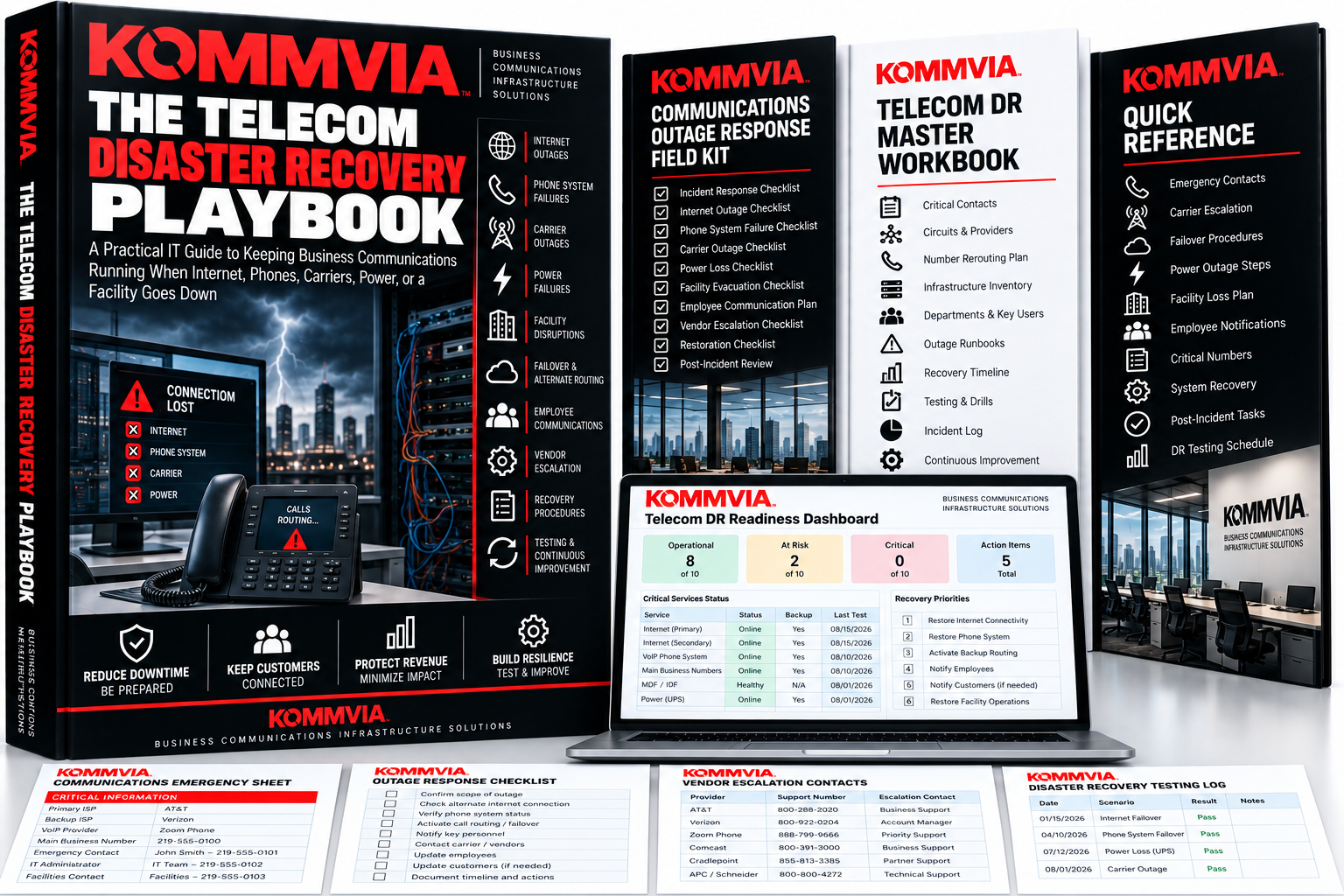

The Telecom Disaster Recovery Playbook
A Practical IT Guide to Keeping Business Communications Running When Internet, Phones, Carriers, Power, or a Facility Goes Down
What happens when your internet, phone system, carrier, power, or entire facility suddenly goes down?
The Kommvia Telecom Disaster Recovery Playbook gives IT teams a practical system for preparing for communications outages before they happen—and responding quickly when they do.
Document critical services, backup connectivity, phone-number routing, carrier escalation paths, infrastructure dependencies, outage runbooks, recovery procedures, and disaster-recovery testing in one organized system.
Includes the complete playbook, Communications Outage Response Field Kit, emergency checklists, and interactive Telecom DR Master Workbook.
Reduce downtime. Keep customers connected. Know what to do next.
Original price was: $6.97.$3.00Current price is: $3.00.
If Your Phone System Disappeared Tomorrow, How Would Customers Reach You?
Your primary internet circuit goes down.
Your VoIP provider has an outage.
The MDF loses power.
Your main business number suddenly stops routing.
Or the entire building becomes inaccessible.
What happens next?
Most organizations have backups somewhere. They have vendor contacts somewhere. Someone probably knows how the phones are configured.
But during an actual outage, “somewhere” isn’t good enough.
The Kommvia Telecom Disaster Recovery Playbook gives IT teams a practical system for documenting critical communications infrastructure, planning for common failure scenarios, building recovery procedures, and testing those procedures before an emergency happens.
IDENTIFY WHAT MUST KEEP WORKING
Not every system has the same business impact.
Determine which communications functions are truly critical:
Main Business Numbers • Customer Service • Sales • Emergency Communications • Internet Connectivity • Critical Users • Remote Workers • Business Applications
Then establish recovery priorities and acceptable outage windows.
BUILD YOUR CRITICAL INFRASTRUCTURE INVENTORY
Document the systems your communications environment depends on.
Track:
Internet Circuits • Voice Carriers • VoIP/UC Platforms • PBX Systems • Firewalls • Switches • Gateways • MDF/IDF Rooms • UPS Systems • Critical Numbers • Specialty Systems
When something fails, you shouldn’t have to reverse-engineer the environment before troubleshooting can begin.
PLAN FOR REAL FAILURE SCENARIOS
Build specific response plans for situations such as:
Primary ISP Outage • Backup ISP Failure • VoIP Provider Outage • SIP/Carrier Failure • PBX Failure • Firewall/Core Switch Failure • MDF/IDF Power Loss • Building Inaccessible • Main Number Routing Failure • Key Administrator Unavailable
Know what the first checks are, who owns the response, when to escalate, and what recovery options exist.
DESIGN INTERNET CONTINUITY
Document what happens when your primary connection disappears.
Identify backup circuits, diverse paths, firewall failover configuration, cellular contingencies, bandwidth limitations, critical traffic priorities, provider contacts, and testing procedures.
A backup connection only helps if you know it actually works.
KEEP YOUR BUSINESS NUMBERS REACHABLE
Your telephone numbers are often one of the most important communications assets your business owns.
Document:
Main Numbers • DIDs • Providers • Normal Destinations • Alternate Destinations • Rerouting Procedures • Authorized Contacts • Criticality
Know exactly how critical calls can be redirected if the normal phone environment becomes unavailable.
PREPARE FOR POWER AND FACILITY FAILURES
Communications infrastructure depends on physical infrastructure.
Document UPS coverage, expected runtime, PoE dependencies, carrier equipment, switches, firewalls, gateways, and other equipment required to keep communications operating.
Then plan for the bigger scenario:
What happens if nobody can access the building at all?
BUILD THE VENDOR ESCALATION MATRIX
When something fails, don’t start searching invoices for a support number.
Maintain an organized escalation system containing:
Provider • Service • Account/Circuit Reference • Support Path • Authorized Contact • Escalation Procedure • After-Hours Process • SLA Reference
Get the right vendor involved faster.
CREATE OUTAGE RUNBOOKS
Turn tribal knowledge into repeatable procedures.
The system helps you build practical runbooks covering:
Internet Failures • Phone Failures • Carrier Outages • Power Failures • Network Failures • Facility Disruptions
Each runbook establishes what to check, who owns the incident, when to fail over, when to reroute communications, who contacts vendors, how employees are notified, and how recovery is validated.
CREATE YOUR COMMUNICATIONS EMERGENCY SHEET
One of the most valuable pieces of the package is a concise operational reference for an actual emergency.
Keep the essentials accessible:
Critical Providers • Primary & Backup Circuits • Main Numbers • Alternate Routing • Critical Contacts • Vendor Escalations • Infrastructure References • Immediate Response Actions
No passwords or sensitive credentials belong on the sheet. Those should remain in your organization’s approved secure credential system.
CONTROL INCIDENT COMMUNICATIONS
Technical troubleshooting isn’t enough.
Someone needs to own the incident.
Someone needs to update leadership.
Employees need instructions.
Providers need escalation.
And everyone needs to know when the next update is coming.
The playbook helps establish that structure before the pressure starts.
TEST BEFORE THE REAL OUTAGE
A disaster recovery plan that has never been tested is still largely an assumption.
Build a testing program around:
Internet Failover • Call Rerouting • Remote Users • Vendor Escalation • UPS/Power • Administrative Access • Building-Loss Scenarios • Recovery to Normal Operations
Record results, identify gaps, assign corrective actions, and improve the plan.
LEARN FROM EVERY INCIDENT
Every outage should leave the communications environment stronger.
Document the timeline, business impact, root cause, vendor performance, successful workarounds, documentation gaps, corrective actions, and lessons learned.
Then update the runbook.
What’s Included
The Telecom Disaster Recovery Playbook
The complete step-by-step system for communications continuity, outage preparation, response, recovery, and testing.
Communications Outage Response Field Kit
Print-ready checklists covering initial outage triage, internet failures, phone failures, building/power failures, recovery, and post-incident review.
Telecom DR Master Workbook
An interactive Excel management system covering:
Dashboard • Critical Services • Critical Numbers • Circuits & Connectivity • Infrastructure Dependencies • Vendor Escalation • Runbooks • Communications Emergency Sheet • Risks • DR Testing • Incident Log • Corrective Actions
Built for the People Responsible When Communications Stop Working
Ideal for:
IT Managers • IT Directors • Network Administrators • Systems Administrators • Infrastructure Teams • MSPs • Facilities Teams • Operations Managers • Multi-Site Organizations
Don’t Build the Plan During the Outage.
Know what’s critical.
Know your alternatives.
Know who to call.
Know what to do.
Test it before you need it.
Kommvia — Business Communications Infrastructure Solutions
Related products
-
The Telecom Cost Reduction Playbook
Original price was: $6.97.$3.00Current price is: $3.00. -
The Multi-Site Telecom Audit Playbook
Original price was: $6.97.$3.00Current price is: $3.00. -
The Structured Cabling Standards Kit
Original price was: $6.97.$3.00Current price is: $3.00.