
The Most Valuable Part of Your Old Phone System Isn’t the Phone System
September 16, 2026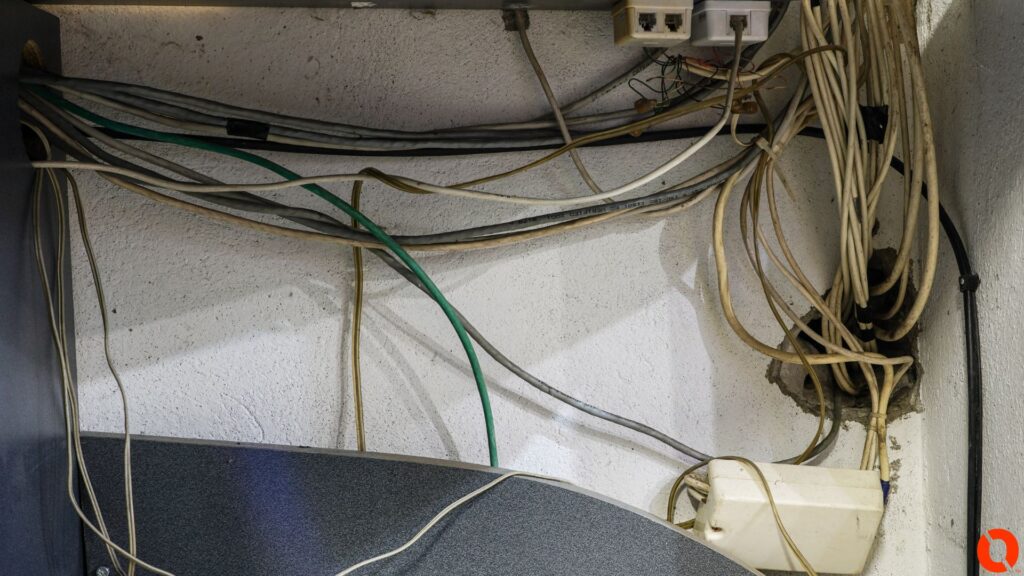
Walk into an older commercial building, lift a ceiling tile, and there’s a good chance you’re looking at a history lesson.
CAT5 from an old network. Telephone cable from a PBX that disappeared years ago. Coax that once fed something nobody remembers. Cables cut at one end and disappearing into another part of the building. Old drops from offices that don’t exist anymore. Bundles installed by contractors who haven’t worked in the building for fifteen years.
Some of it is active.
Some of it isn’t.
The interesting part is that nobody is completely sure which is which.
At Kommvia, we run new structured cabling all the time, but sometimes the first thing a building needs isn’t another cable. It needs somebody to understand what’s already above the ceiling.
Buildings Rarely Get a Clean Slate
Technology changes much faster than commercial buildings do.
A company replaces its phone system, but the old telephone cabling may stay. The office gets remodeled, but the abandoned network drops remain above the ceiling. New wireless access points are installed and new cable is pulled alongside infrastructure from two generations of Wi-Fi equipment.
Then another tenant moves in and starts the process again.
None of this is particularly surprising. Removing old cabling costs money, and during a technology upgrade the priority is usually getting the new system operational. Once everything works, there’s very little enthusiasm for going back into the ceiling to deal with infrastructure nobody is using anymore.
So it stays.
Years become decades, and eventually the building develops something we see fairly often: layers of telecommunications infrastructure from different eras occupying the same pathways.
It’s technology archaeology.
The Problem Isn’t That the Cable Is Old
Old cabling isn’t automatically bad cabling.
There are plenty of older cable runs still doing exactly what they were installed to do. If a run is appropriate for the application, properly installed, in good condition, and performing as required, age by itself doesn’t make it a problem.
The bigger issue is abandoned infrastructure.
When unused cables remain mixed with active ones, the building becomes harder to understand and harder to service. Pathways fill up. Cable trays become crowded. New installers have to work around infrastructure that may serve no purpose. Troubleshooting becomes more difficult because every unidentified cable is another question.
Eventually, the ceiling can contain far more cabling than the current network actually requires.
That’s when adding “just one more cable” starts becoming more complicated than it sounds.
Don’t Cut the Mystery Cable
Of course, there’s an important rule before removing anything:
Know what it does.
A cable with no label isn’t necessarily abandoned. The fact that nobody in the office recognizes it doesn’t mean it isn’t serving something important.
This is particularly true in buildings where telecommunications infrastructure has evolved over many years. A cable may feed a remote network switch, wireless access point, phone, paging interface, printer, control device, or another piece of equipment that’s easy to overlook.
There can also be infrastructure associated with systems outside the normal IT environment.
This is why cleanup shouldn’t begin with a pair of cutters.
It begins with investigation.
Trace what can be traced. Check terminations. Look at patch panels. Identify active equipment. Review available documentation. Talk to the people who know the facility. Determine what is active, what is abandoned, and what nobody should touch until there’s a better answer.
Cutting cables is easy.
Knowing which ones to cut is the job.
The Telecom Room Usually Provides the First Clues
If the ceiling is the archaeological site, the telecom room is usually the museum.
Old patch panels can reveal what kinds of systems were once installed. Punch blocks may still contain active voice circuits. Newer network switches might be connected through cabling that disappears into bundles installed decades earlier.
Sometimes you’ll find cables neatly labeled with room numbers that no longer exist because the building was remodeled.
Other times you’ll find labels like “MIKE,” “BACK,” or “DO NOT REMOVE.”
Those are always fun.
The room tells a story about how the facility changed. The challenge is separating history from infrastructure the business still depends on.
This is also why good documentation matters so much on new installations. Every cable we label today is one less mystery someone has to solve years from now.
Abandoned Cable Can Make New Projects Harder
The cost of old infrastructure isn’t always obvious until a company needs something new.
Maybe the business wants additional Wi-Fi access points in the warehouse. Another department is moving into a renovated area. New VoIP phones need network drops. Workstations are being added. A network expansion requires additional cabling between spaces.
Now installers need pathways.
If trays, sleeves, and accessible routes are already packed with abandoned infrastructure, the old cabling starts affecting the new project.
Instead of simply installing the new runs, someone may first need to determine what can safely be removed or find another pathway through the building.
That’s when years of “we’ll leave it there for now” begin collecting interest.
Infrastructure debt works a lot like financial debt. Ignoring it is easy when nothing is changing.
You notice it when you need room to grow.
The Wireless Future Still Needs Cable Above the Ceiling
It’s tempting to think this problem will disappear as businesses become more wireless.
It probably won’t.
Wireless access points still need infrastructure. In most commercial environments, an AP is connected to Ethernet cabling that provides network connectivity and often Power over Ethernet from a switch.
As businesses become more dependent on Wi-Fi, access-point placement becomes more important, and that often means pulling cable to locations selected for wireless performance rather than convenience.
VoIP has also moved many phones onto Ethernet networks. Cameras, building systems, and other connected devices continue moving toward IP.
We’re not eliminating cabling.
We’re changing what connects to it.
That makes clean pathways and understandable infrastructure even more valuable.
Sometimes a Cabling Project Should Begin With Removal
When businesses call about structured cabling, the assumption is usually that the project involves installing something.
Sometimes the better first project is taking something away.
A proper cleanup can include identifying active runs, removing confirmed abandoned cabling where appropriate, reorganizing patching, correcting labels, documenting important connections, and creating usable space for future infrastructure.
The result may not be something most employees ever see.
That’s fine.
Nobody walks into an office and compliments the amount of available space in the cable tray.
But the next technician will notice.
So will the company when it needs to expand.
Leave Something the Next Technician Can Understand
This is one of the standards we think about when working on structured cabling.
Someday, someone else is going to work on it.
Maybe that’s us. Maybe it’s the customer’s IT department. Maybe it’s another contractor fifteen years from now.
Whoever it is shouldn’t have to reverse-engineer every decision made during the installation.
Label the cable. Organize the patch panel. Use sensible pathways. Test the runs. Remove what should be removed. Document what matters.
Structured cabling is supposed to bring order to communications infrastructure. If every project simply adds another layer without considering what’s already there, eventually the structure disappears.
So the next time you’re standing in an office and everything looks clean and modern, remember that there may be another building entirely hiding three feet above your head.
Twenty years of telephone systems, networks, remodels, expansions, abandoned equipment, and forgotten cables.
Your ceiling remembers all of it.
At Kommvia, sometimes our job is helping the building forget.
We’re Here To Help!!
Kommvia provides structured cabling installation, additions, moves and changes, troubleshooting, testing, cable management, infrastructure cleanup, Wi-Fi access-point cabling, network infrastructure, and business phone systems for commercial and industrial facilities throughout Northern Indiana, Northwest Indiana, South Michigan, and the Chicago area.
Have a telecom room or ceiling full of cabling nobody understands? Before adding another layer, let’s figure out what’s already there.
1-844-KOMMVIA | COMMAND THE SIGNAL™